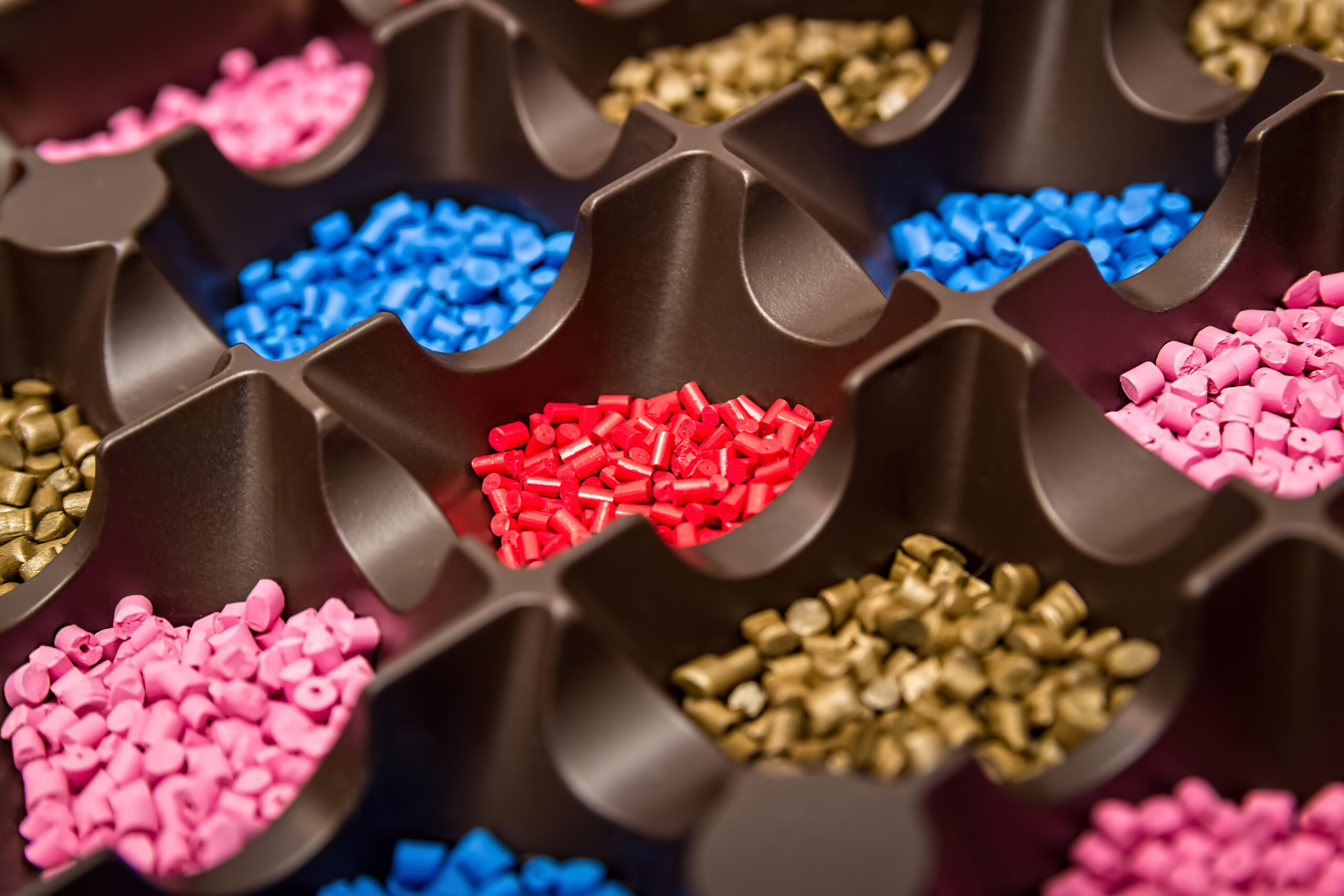
Material selection is one of the first major decisions in any injection molding materials projects and one of the most rewarding to get right.
Choose the ideal resin for your application, and you gain a competitive edge before a single unit ships: Parts that perform as designed, tooling that runs efficiently, and a specification that holds up through validation and into production.
The Four Questions That Drive Every Material Decision
Before comparing specific resins, get clear on what your part needs to do. These four questions will guide you to the right selection
- What loads will the part carry? Strength, stiffness, and fatigue resistance vary widely across resins. Define your load case early.
- What temperatures will the part experience? Consider both the service environment and any processing steps like sterilization or paint curing. A resin that performs at room temperature may warp under heat.
- What will the part be exposed to? Fuels, cleaning agents, UV light, and moisture all affect plastics differently. Real-world exposure conditions should drive this call, not just a data sheet.
- Are there regulatory requirements? Medical, food-contact, and automotive parts all carry compliance obligations that can take certain materials off the table entirely. Know your requirements before you commit to a spec.
Common Injection Molding Materials and When to Use Them
| Resin | Typical Applications | Strengths | Limitations |
| Polypropylene (PP) | Consumer goods, packaging, automotive interiors | Low cost, chemical resistance, recyclability | Lower stiffness, poor UV resistance without additives |
| ABS | Electronics housings, power tools, consumer products | High impact strength, good surface finish, easy to paint/plate | Limited heat resistance, not ideal for outdoor UV exposure |
| Nylon (PA) | Gears, bearings, structural brackets | Excellent fatigue resistance, self-lubricating | Absorbs moisture, dimensional stability can vary |
| Polycarbonate (PC) | Optical lenses, safety shields, medical devices | High impact resistance, optical clarity, broad thermal range | Higher cost, susceptible to certain chemicals |
| HDPE | Containers, caps, piping components | Excellent chemical resistance, food-safe grades available | Lower stiffness, surface hardness |
| PEEK | Aerospace, surgical instruments, high-load structural parts | Exceptional strength, heat resistance to 250°C+, biocompatible | High material and processing cost |
| PPS | Electronics housings, automotive fuel systems | Excellent dimensional stability at elevated temperatures | Brittle without glass reinforcement |
How Reinforcements Change the Equation
Glass fiber, carbon fiber, and mineral fillers can significantly alter the performance profile of a material, often in ways that change which resin makes sense.
Glass-filled nylon, for example, dramatically improves stiffness and reduces moisture absorption, which addresses two of the base resin’s main limitations. Carbon fiber reinforcement raises the strength-to-weight ratio to near-metal levels while reducing part weight, a profile increasingly specified in aerospace and automotive lightweighting programs.
The tradeoff: Reinforcements affect flowability during injection, require higher barrel temperatures, and can cause anisotropic shrinkage that complicates mold design. These process implications are best evaluated early, with a molder who has experience running filled materials at production volumes.
Injection Molding Material Selection in Regulated Industries
If your part goes into a medical device, food-contact product, or defense application, compliance defines your material options before anything else does. Documented material traceability, validated processes, and the right quality certifications are just as important as the resin itself.
A few things to know going in:
- Medical-grade resins must meet ISO 10993 biocompatibility standards
- Implantable components narrow the field further, with PEEK, certain polycarbonates, and polysulfone being the most proven options
- Food-contact parts require FDA-compliant resin grades with controlled additive packages
Working With Mako Plastics For Your Material Selection
Mako Plastics works with a full range of commodity and engineering resins at its Texas facility, with design optimization built into every project from the start. Whether you’re early in your design phase or refining an existing specification, Mako’s team can help you evaluate your injection molding materials options against your performance requirements, processing constraints, and cost targets.